
Digital by Default: What Omnibus IV Means for Product Compliance
The EU agreed a 'digital by default' approach to product compliance under Omnibus IV. Here's what changes, and why it's really about data, not documents.
By Complir
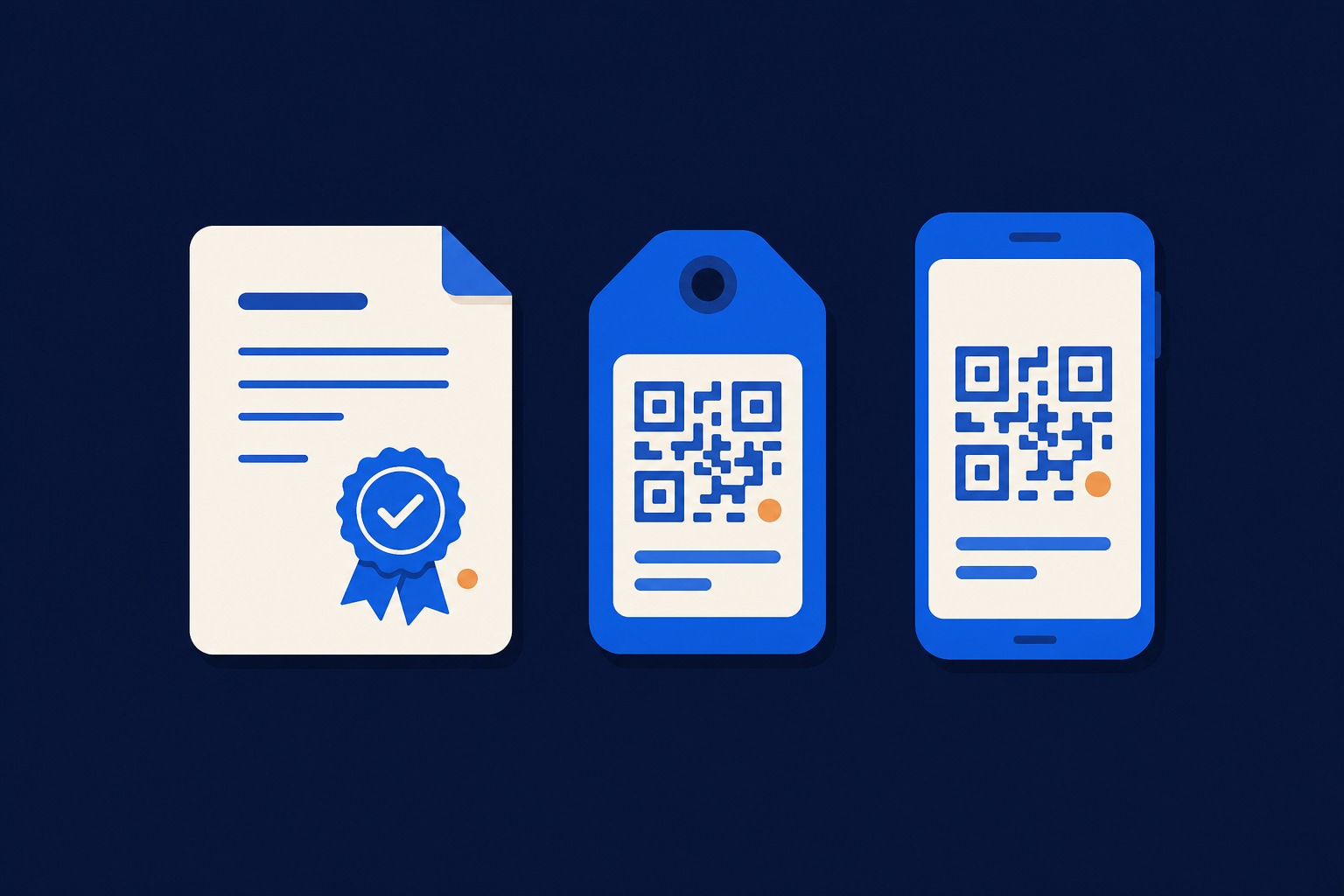
Omnibus IV is the EU's fourth simplification package for product rules. On 9 June 2026, the Council of the EU and the European Parliament reached a provisional agreement to make product compliance information digital by default across the Single Market, amending 20 pieces of EU product legislation to move compliance off paper and onto digital channels.
The headline framing is "less paperwork." That is true, but it undersells what is happening. The deeper shift is from compliance as a stack of documents to compliance as a body of structured, living data, generated, maintained, and shared digitally across a product's life. Companies organised around the document will feel friction. Companies organised around the data will move faster.
This article explains what was actually agreed, what is genuinely new, what is not changing, and why the underlying direction matters more than the individual measures.
What Omnibus IV Agreed
The digitalisation strand of the EU's fourth simplification package
Omnibus IV is a European Commission simplification package proposed on 21 May 2025. On 9 June 2026, the Council presidency and Parliament negotiators reached a provisional political agreement on its digitalisation strand. The new rules apply the "digital by default" principle to existing product legislation, allowing compliance information that today must be printed to be provided and exchanged digitally instead.
One point of precision that matters for planning: this is a provisional agreement, not yet law. Before it applies, the text still has to be formally endorsed by both the Council and the Parliament, pass legal-linguistic revision, and be published in the EU Official Journal. The substance is now stable enough to prepare for, but the final text and dates can still move.
What "Digital by Default" Changes
Five recurring shifts across twenty product laws
The agreement covers two linked instruments: a draft Regulation amending seven existing regulations, and a draft Directive amending thirteen existing directives, twenty product laws in total, spanning areas such as machinery, personal protective equipment, gas appliances, pressure equipment, RoHS, marine equipment, the Battery Regulation, and the Ecodesign for Sustainable Products Regulation (ESPR).
Across those laws, the recurring changes are consistent:
Digital EU Declaration of Conformity (DoC). The Declaration of Conformity, the manufacturer's formal statement that a product meets EU requirements, can be provided digitally, including via an internet address or machine-readable code such as a QR code, rather than as a printed document travelling with the product.
Digital instructions for use. Manufacturers may provide instructions in digital form instead of on paper, under sector-specific conditions and with safeguards for end users.
A mandatory digital contact point. Manufacturers must provide a digital contact, a freely accessible online channel such as an email address or a website contact form. It cannot require registration, a dedicated app, or disclosure of personal data simply to reach the economic operator.
Digital exchanges with authorities. Communication between economic operators and national market surveillance authorities can move to electronic channels, replacing paper-based correspondence.
Common specifications as a fallback. Where harmonised standards are missing, insufficient, or not available in time, the Commission can adopt "common specifications" as an alternative route to demonstrating conformity. This is explicitly framed as an exceptional, last-resort mechanism, not a replacement for the established standardisation process.
The Safeguards
Paper does not disappear entirely
The agreement is deliberately not a blanket "everything becomes a QR code" rule. Two safeguards are built in.
First, where there is a risk of serious harm to consumers, safety information must still be available in paper form. Second, essential safety information and on-product warnings remain physical where the underlying acts require them. The simplification targets the administrative layer (declarations, instructions, formal correspondence), not the critical safety content a user needs in their hands at the moment of use.
This is worth stating clearly in any internal discussion, because the "paper is dead" reading overstates the change and creates avoidable compliance risk.
What Is Not Changing
Keeping the picture honest next to the DPP
Because Omnibus IV sits next to high-profile rules like the Digital Product Passport, it is easy to over-read. A few boundaries keep the picture honest:
- It does not change Digital Product Passport timelines. The battery passport still applies from 18 February 2027, the detergents DPP from 23 September 2029, and the toy DPP from 1 August 2030.
- It does not create new DPP data fields or a universal DPP obligation. Those are set in sector-specific delegated acts, not in this package.
- It does not make all instructions and safety information QR-only. Scope stays sector-specific, and paper safeguards remain.
- It does not replace harmonised standards. Common specifications are a fallback, not the new default.
There is one neat point of convergence worth noting. Where another EU law already requires a Digital Product Passport for a product, certain Declaration of Conformity and instruction information can be stored only in that passport, rather than duplicated across separate systems. That is a small but telling signal: the EU is starting to treat the digital passport as the single place compliance information lives.
Data, Not Documents
Why the direction of travel matters more than the measures
Strip away the legal mechanics and a pattern emerges. A Declaration of Conformity you can auto-generate, serve through a web link or QR code, keep current across a product's life, and, where a passport exists, store in one canonical location, is no longer a document in any meaningful sense. It is a view onto underlying compliance data.
That reframes the core question for any product business. The hard part stops being "where is the right PDF, in the right language, with the right version" and becomes "is our compliance data structured, current, sourced from suppliers we trust, and ready to be served on demand to a customer, a marketplace, or an authority."
Most companies today are not organised this way. Compliance lives in shared drives, email threads, supplier attachments, and spreadsheets, a document-centric setup that worked when the deliverable was a binder. As the EU moves the deliverable to a live digital channel, that setup becomes the bottleneck.
“"Digital by default" sounds like a formatting change, but it quietly raises the bar on data quality. A printed Declaration of Conformity hides a multitude of sins; the moment that same statement is served live through a QR code and, eventually, a Digital Product Passport, the underlying data has to be correct, current, and traceable to a supplier. The teams that win are not the ones that digitise their PDFs. They are the ones that treat every product as a single structured compliance record the document can simply render.”
Complir Team
Product Compliance, Complir
The organisations that will adapt cleanly are the ones that can do five things as a matter of routine: collect compliance information from suppliers in a structured, repeatable way; maintain a single source of truth for each product's regulatory data; generate Declarations of Conformity automatically from that data; provide direct digital access via web links or QR codes; and share that information with customers and authorities, feeding it into Digital Product Passports as those obligations arrive.
None of this is a new legal requirement created by Omnibus IV. It is the operating model the regulation's direction of travel quietly rewards.
What To Do Now
Operational preparation that pays off regardless of the final text
For most product businesses, the right preparation is not legal, it is operational, and it is worth starting before the text is final, because it pays off regardless of the exact wording.
Structure your product data
Composition, test evidence, supplier traceability, identifiers, declarations. This is the same work whether your compliance information ends up on paper or on a QR code, and it is the precondition for everything digital.
Establish a single source of truth per product
Decide where each product's authoritative compliance record lives, and make sure the DoC and supporting evidence are generated from it rather than maintained as loose copies.
Map where digital obligations already touch you
If any products fall under the Battery Regulation, ESPR, or another passport regime, those are the first places digital-by-default and single-location storage will bite, and the best place to pilot a cleaner process.
Watch the closing legislative steps
The provisional agreement still needs formal adoption and Official Journal publication. Track those for the final scope, transition periods, and dates that will apply to your sectors.
Frequently Asked Questions
Common questions about Omnibus IV and digital by default
Is Omnibus IV now law?
No. As of June 2026 it is a provisional political agreement. It still requires formal endorsement by the Council and Parliament, legal-linguistic revision, and publication in the Official Journal before it applies. The final text may differ from the agreed version.
Does "digital by default" mean no more paper at all?
No. Where there is a risk of serious harm, safety information must still be available on paper, and essential warnings remain on the product. The change targets declarations, instructions, and formal correspondence, not critical safety content.
What is a digital Declaration of Conformity?
It is the same legal statement of conformity, made available digitally, for example through an internet address or a machine-readable code such as a QR code, instead of, or in addition to, a printed copy travelling with the product. The CE marking obligation behind it does not change.
Does this change the Digital Product Passport deadlines?
No. Omnibus IV does not alter DPP timelines. The battery passport still applies from 18 February 2027, detergents from 23 September 2029, and toys from 1 August 2030.
What are common specifications?
Common specifications are technical specifications the Commission can adopt to provide a route to conformity when harmonised standards are unavailable or insufficient. Under Omnibus IV they are an exceptional fallback, not a replacement for the standardisation process.
Which products are affected?
The package amends 20 EU product laws, including rules on machinery, personal protective equipment, gas appliances, pressure equipment, RoHS, marine equipment, the Battery Regulation, and ESPR. The specific effects vary by sector.
The Bottom Line
The document is becoming a rendering of the data behind it
Omnibus IV's "digital by default" agreement is a simplification measure on paper and a structural signal in practice. The EU is steadily making the digital channel, web links, QR codes, and ultimately Digital Product Passports, the place compliance information lives. The document is becoming a rendering of the data behind it.
The work that follows is not about managing more documents. It is about managing compliance data well enough that the document can generate itself, stay current, and be served to anyone who asks. That is the capability we built Complir around: a single, structured compliance record per product, with Declarations of Conformity generated from it and supplier evidence collected into it, so that as the EU's digital requirements arrive, the data is already there to meet them.
If your compliance information still lives across drives, inboxes, and spreadsheets, the digital-by-default shift is a good reason to change that now, while it is still preparation, not catch-up. See how Complir maps every product to every applicable regulation.
Sources & References
- Council of the EU, "Simplification: Council and Parliament strike deal to help growing businesses thrive and accelerate digitalisation" (press release, 9 June 2026)
- European Commission, Omnibus IV package overview
- Commission proposal COM(2025) 504, Regulation on digitalisation and common specifications (EUR-Lex)
- Commission proposal COM(2025) 503, Directive on digitalisation and common specifications (EUR-Lex)
- Council of the EU, "Council agrees positions on digitalisation and common specifications" (press release, 24 September 2025)
- Regulation (EU) 2024/1781 (ESPR), EUR-Lex
- Regulation (EU) 2023/1542 (Battery Regulation), EUR-Lex
This article is for informational purposes only and does not constitute legal advice. Omnibus IV is a provisional agreement and its scope, transition periods, and dates may change before adoption. Consult a qualified compliance advisor for guidance specific to your products and markets.
Related articles
The EU DPP Registry Is Live: What Product Companies Need to Do Now
The European Commission launched the Digital Product Passport Registry on 20 July 2026. What it does, who must register, and how to prepare before 2027.

Product Compliance Management: How to Build a Scalable Compliance Process
What product compliance management involves, how to structure the workflow, team, and tools, and how to scale it across markets and thousands of SKUs.

EU Toy Safety Regulation: What Changed and When It Applies
The new EU Toy Safety Regulation is in force. What changed vs the Toy Safety Directive, deadlines to 2030, and the toy Digital Product Passport explained.
Launch products globally without compliance bottlenecks.
Complir's AI agents handle the regulations and documentation across every market you sell in - and keep your entire catalogue audit-ready.