
Digital Product Passport (DPP): What It Is, Who Needs One, and When
The Digital Product Passport explained – what the EU DPP is, which products need one, when it applies, and how product companies should prepare.
By Complir

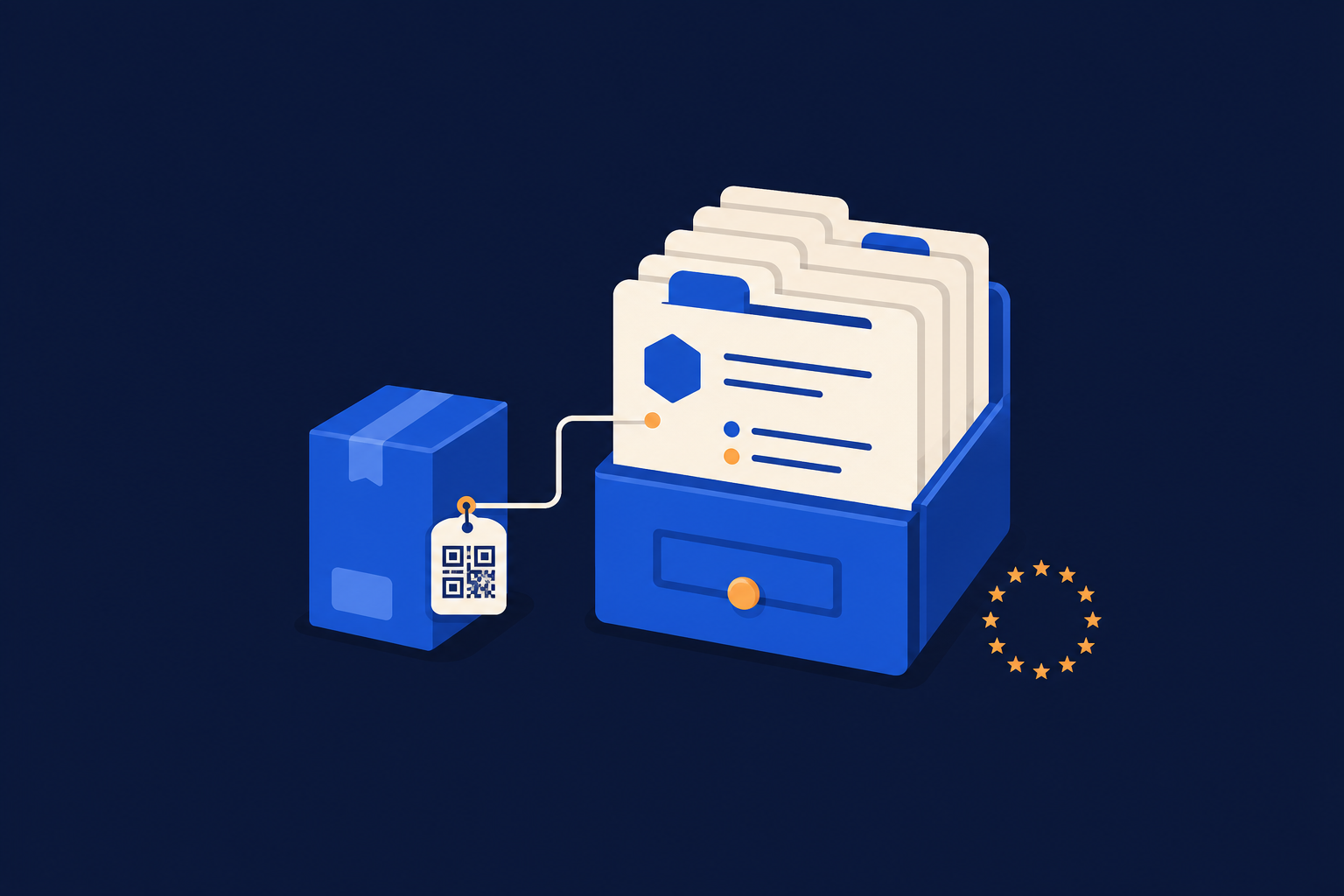
The Digital Product Passport (DPP) is a structured digital record – attached to a physical product via a QR code or similar data carrier – that stores information about the product's identity, composition, supply chain, and sustainability. It is introduced by the EU's Ecodesign for Sustainable Products Regulation (EU) 2024/1781 (ESPR), which entered into force on 19 July 2024 and will progressively apply to most physical products sold in the EU.
The first mandatory digital passport – the battery passport – takes effect on 18 February 2027 under the EU Battery Regulation (EU) 2023/1542. The European Commission's central DPP registry is scheduled to go live on 19 July 2026, and the first ESPR product-specific delegated acts (starting with iron and steel) are expected to be adopted in 2026, with textiles and tyres following in 2027. If you make or import consumer products for the EU market, a DPP will affect your business within the next three to five years – and the preparation work starts with your product data.
What Is the Digital Product Passport?
A digital identity card for every product on the EU market
The Digital Product Passport is a digital identity card for a physical product. It carries structured information about what the product is, what it is made of, where its components came from, how it performs on sustainability metrics, and how it can be repaired, reused, or recycled. That information is accessible to consumers, businesses, repairers, recyclers, and market surveillance authorities via a data carrier – typically a QR code – printed on the product or its packaging.
The DPP is established by the Ecodesign for Sustainable Products Regulation (EU) 2024/1781. ESPR is a "framework" regulation, meaning it sets the rules of the game but leaves the specific DPP requirements – which product data fields, which performance thresholds, which labelling – to category-by-category delegated acts that the European Commission adopts over time.
Put simply: ESPR says every in-scope product will eventually need a DPP. The delegated acts say what that DPP looks like for your specific product category, and when it becomes mandatory.
Why the EU introduced the DPP
The European Commission's goal with the DPP is to make products more circular – easier to repair, reuse, and recycle – and to give everyone in the value chain, from consumers to customs authorities, a reliable way to check what a product actually contains. Today, most of that information is scattered across suppliers, factories, internal spreadsheets, and paper documents. A recycler who wants to know what plastic a casing is made of, or a consumer who wants to know whether a garment contains hazardous substances, usually cannot find out.
The DPP is the EU's structural answer: one standardised, machine-readable record per product, accessible via a scannable identifier, covering the full range of product data relevant to sustainability and compliance.
It also serves an enforcement function. Once the central registry and product-level DPPs are in place, market surveillance authorities, customs officials, and online marketplaces can verify compliance at scale – not one product at a time.
Which Products Will Need a DPP
Scope, priorities, and the 2025–2030 roadmap
Almost every physical product sold in the EU is eventually in scope. ESPR covers all products placed on the EU market or put into service, with limited exceptions for food, feed, medicinal products, and a few other categories. What matters for most companies is the order in which the Commission rolls out the delegated acts.
Batteries come first (February 2027)
The battery passport is technically separate from ESPR – it comes from the EU Battery Regulation (EU) 2023/1542. But in practice it operates as the DPP system's proof-of-concept. From 18 February 2027, a digital battery passport, retrievable via a QR code, is mandatory for all electric vehicle batteries, industrial batteries, and light-means-of-transport batteries placed on the EU market with a capacity greater than 2 kWh.
ESPR priority products (2026–2029)
The Commission's ESPR Working Plan 2025–2030, adopted on 16 April 2025, named the first priority product categories. Each delegated act includes a minimum 18-month transition period before requirements become enforceable.
| Product Group | Delegated Act Target | Estimated Compliance Date |
|---|---|---|
| Iron and steel (intermediate) | 2026 | ~2028 |
| Textiles and apparel | 2027 | ~Late 2028 / 2029 |
| Tyres | 2027 | ~2029 |
| Furniture | 2028 | ~2030 |
| Aluminium (intermediate) | 2028 | ~2030 |
| Mattresses | 2029 | ~2031 |
That means a textile brand should expect DPP obligations to bite in 2028 or 2029, not the day the delegated act is published.
What about products not yet on the priority list?
If your product category is not in the 2025–2030 Working Plan, you are not obligated yet. But the Commission has signalled that electronics, detergents, chemicals, and many other categories will follow in subsequent working plans. Treat the priority list as the starting menu, not the whole menu.
Quick check
Are you ready for the DPP?
Five questions, based on the scope and roadmap above. Nothing is stored.
- 1
Do you place physical products on the EU market?
What Data a DPP Contains
The categories of information and who can access them
ESPR does not prescribe a single DPP data set – that is the job of each product-specific delegated act. However, the regulation sets the categories of information a DPP may require, and the Commission has signalled which fields will feature across most categories:
- Product identity – unique product identifier, model, manufacturer, EU economic operator, place of manufacture.
- Material composition – substances of concern, recycled content, origin of key materials.
- Environmental performance – carbon footprint, energy use, durability, reparability score.
- Supply chain – components, suppliers (where applicable), tier transparency.
- End-of-life – repair instructions, spare parts availability, disassembly guidance, recycling information.
- Compliance – declarations of conformity, certifications, test reports relevant to the product's regulatory requirements.
Who can see which fields is also regulated. ESPR provides for differentiated access rights – some information is public, some is restricted to repairers and recyclers, and some is accessible only to market surveillance authorities. The specifics are set in each delegated act.
How a DPP Works in Practice
Data carriers, unique identifiers, and the EU registry
Three technical components sit behind every DPP.
A data carrier – typically a QR code, but ESPR allows for other machine-readable formats. It is physically attached to the product, its packaging, or its accompanying documents. Scanning the carrier resolves to the product's DPP.
A unique product identifier, linked to a unique operator identifier (the economic actor placing the product on the market) and a unique facility identifier (where it was manufactured). These identifiers must be issued in accordance with internationally recognised standards, which is where GS1 and CEN/CENELEC technical work come in.
A central EU registry, operated by the European Commission. According to the Commission's published roadmap, the registry is scheduled to launch on 19 July 2026. The registry does not store the full product data – it stores the unique identifiers and the links to where the data lives. Manufacturers and importers remain responsible for hosting, maintaining, and updating the underlying product information.
This architecture has an important consequence: the DPP is not a new EU database you upload data to. It is a standardised pointer to your own product data. If your product data is scattered, inconsistent, or out-of-date, the DPP will expose it – publicly – to consumers, retailers, marketplaces, and authorities.
“The DPP is not a compliance problem – it is a product-data problem disguised as one. Companies like Flying Tiger Copenhagen, launching 500 new products a month across 44 countries, already rely on structured per-product records to stay ahead of EU regulation. That same foundation is what the DPP will require from every product company.”
Complir Team
Product Compliance, Complir
Digital Product Passport Timeline
The key dates every product company should know
Dates marked "Expected" are indicative timelines from the European Commission's published Working Plan and are subject to the formal adoption process. Dates marked "Confirmed" are fixed in adopted regulation text.
| Date | Milestone | Status |
|---|---|---|
| 19 July 2024 | ESPR (EU) 2024/1781 enters into force | Confirmed |
| 16 April 2025 | ESPR Working Plan 2025–2030 adopted | Confirmed |
| 19 July 2026 | Central EU DPP registry launches | Expected |
| 2026 | Iron and steel delegated act | Expected |
| 18 February 2027 | Battery passport becomes mandatory under Regulation (EU) 2023/1542 | Confirmed |
| 2027 | Textiles and tyres delegated acts | Expected |
| 2028 | Furniture and aluminium delegated acts | Expected |
| 2029 | Mattresses delegated act | Expected |
How to Prepare for the DPP
Five steps product companies can take today
Most companies looking at the DPP for the first time ask the same question: "What do we need to build?" The honest answer is that until your category's delegated act is adopted, you cannot build the final DPP. But you can – and should – start preparing now, because the underlying work is the same regardless of which fields the delegated act eventually mandates.
Map your product data today
Know which systems hold which information – PIM, PLM, ERP, spreadsheets, supplier emails, PDFs. The biggest DPP risk is not the regulation itself; it is discovering, in 2028, that the data you need lives in eighty-seven Excel files and nobody is sure which version is current.
Structure it into a per-product record
One product, one structured record, covering identity, composition, supply chain, sustainability, and compliance data. This is the foundation the DPP will sit on top of.
Get a grip on your supply chain data
Much of what the DPP will require – material origin, substances of concern, recycled content – is data your suppliers hold. Start the conversations now. Suppliers who are asked once tend to respond. Suppliers who are asked for the first time in panic, six months before a deadline, tend not to.
Treat the battery passport as a dress rehearsal
Even if you do not make batteries, the battery passport is the first real-world test of how the EU's data carrier, unique identifier, and registry system works. Watch what trips companies up in early 2027 – those are the lessons for every category that follows.
Decide who owns DPP internally
DPP cuts across quality, regulatory affairs, packaging, sourcing, IT, and sustainability. Without a clear internal owner, the work disperses and nothing gets done until the delegated act forces it.
When should companies start preparing for the DPP?
Now. Structuring your product data, mapping supplier inputs, and assigning internal ownership are steps that pay off the day you start them – regardless of when your category's delegated act is adopted. Companies that wait for final delegated acts will find themselves scrambling to restructure their entire product data landscape under deadline pressure.
Frequently Asked Questions
Common questions about the Digital Product Passport
What is a Digital Product Passport?
A Digital Product Passport is a structured digital record attached to a physical product, accessible via a data carrier such as a QR code, that stores information about the product's identity, composition, supply chain, sustainability performance, and end-of-life options. It is introduced by the EU's Ecodesign for Sustainable Products Regulation (EU) 2024/1781.
Is the Digital Product Passport mandatory?
Yes – but not for every product at the same time. The DPP becomes mandatory product category by product category, as the European Commission adopts delegated acts under ESPR. The battery passport is mandatory from 18 February 2027. Iron and steel, textiles, tyres, furniture, aluminium, and mattresses are on the 2026–2029 adoption roadmap. Other categories will follow in subsequent ESPR working plans.
Who is responsible for creating a Digital Product Passport?
Under ESPR, the economic operator placing the product on the EU market is responsible for the DPP. For EU manufacturers, that is the manufacturer. For products imported into the EU, the importer is responsible. The DPP data must be accurate, maintained, and accessible throughout the product's life cycle.
What is the difference between a battery passport and a Digital Product Passport?
The battery passport is established by the EU Battery Regulation (EU) 2023/1542, not by ESPR. It applies specifically to electric vehicle, industrial, and light-means-of-transport batteries with a capacity above 2 kWh, and becomes mandatory on 18 February 2027. The Digital Product Passport under ESPR is the broader, framework-level system that will apply across most product categories over the coming years. The two systems are designed to be interoperable, and the battery passport is widely viewed as the blueprint for the DPPs that follow.
Does the Digital Product Passport apply to imported products?
Yes. ESPR applies to products placed on the EU market or put into service, regardless of where they are manufactured. Importers of non-EU products carry the DPP obligation for those products once they enter the EU. This is the same scope principle that governs CE marking, GPSR, and most other EU product regulations.
Will the DPP require new software?
Not necessarily new software – but it will require product data to be structured, centralised, and maintainable. Many companies already hold the underlying data across PIM, PLM, ERP, and supplier systems. The work is connecting those sources into a single per-product record, keeping it up to date, and exposing the right fields to the right audiences when the delegated acts require it. Companies with scattered, spreadsheet-driven product data are the most exposed and have the most work ahead.
Key Takeaways
What the DPP means for your business
The Digital Product Passport is coming – gradually, by product category, starting with the battery passport in February 2027 and expanding across ESPR priority products through 2029.
The DPP is not a new database you upload to; it is a standardised pointer to the product data you already (should) hold. That makes product data quality the single biggest determinant of how painful DPP compliance becomes.
The preparation work is not speculative. Structuring your product data, mapping supplier inputs, and assigning internal ownership are steps that pay off the day you start them – regardless of when your category's delegated act is adopted.
The DPP is easiest to absorb as part of a structured process; our guide to product compliance management covers the six-stage lifecycle that structured product data feeds into.
If mapping regulations across your product portfolio and maintaining a single source of truth for product data is already consuming your team's time, the DPP is going to intensify the pressure. See how Complir automates regulation-to-product mapping and structured product records – it is exactly the foundation the DPP will require.
Sources & References
- Regulation (EU) 2024/1781 – Ecodesign for Sustainable Products Regulation (ESPR) – EUR-Lex full text
- Ecodesign requirements for sustainable products – EUR-Lex summary
- ESPR Working Plan 2025–2030 – European Commission, Green Forum
- Regulation (EU) 2023/1542 – Sustainability rules for batteries and waste batteries – EUR-Lex full text
This article is for informational purposes only and does not constitute legal advice. Regulatory requirements may vary by product category, market, and specific circumstances. Consult with a qualified legal professional for compliance guidance specific to your situation.
Related articles
The EU DPP Registry Is Live: What Product Companies Need to Do Now
The European Commission launched the Digital Product Passport Registry on 20 July 2026. What it does, who must register, and how to prepare before 2027.

ESPR Explained: What the Ecodesign for Sustainable Products Regulation Means for Your Business
What is ESPR? Learn what the EU Ecodesign for Sustainable Products Regulation requires, which products are covered, key deadlines, and how to prepare.

Digital by Default: What Omnibus IV Means for Product Compliance
The EU agreed a 'digital by default' approach to product compliance under Omnibus IV. Here's what changes, and why it's really about data, not documents.
Launch products globally without compliance bottlenecks.
Complir's AI agents handle the regulations and documentation across every market you sell in - and keep your entire catalogue audit-ready.